Loading...
On August 28, 2023, the Ministry of Transport of the Socialist Republic of Vietnam issued an official letter recommending the second version of theSafe School Zones Guide Vietnam (SSZ Guide)as the first national reference material on safe school zones. Based on the encouraging results of the pilot study as well as the feedback from the government, theSSZ Guidewill be scaled up to build the evidence base to support legislation establishing a legal school zone definition in Vietnam – which would require all school zone developments to meet a minimum safety standard aligned with the parameters of theSSZ Guide.
Government of Vietnam endorses the Safe School Zones Guide nationwide
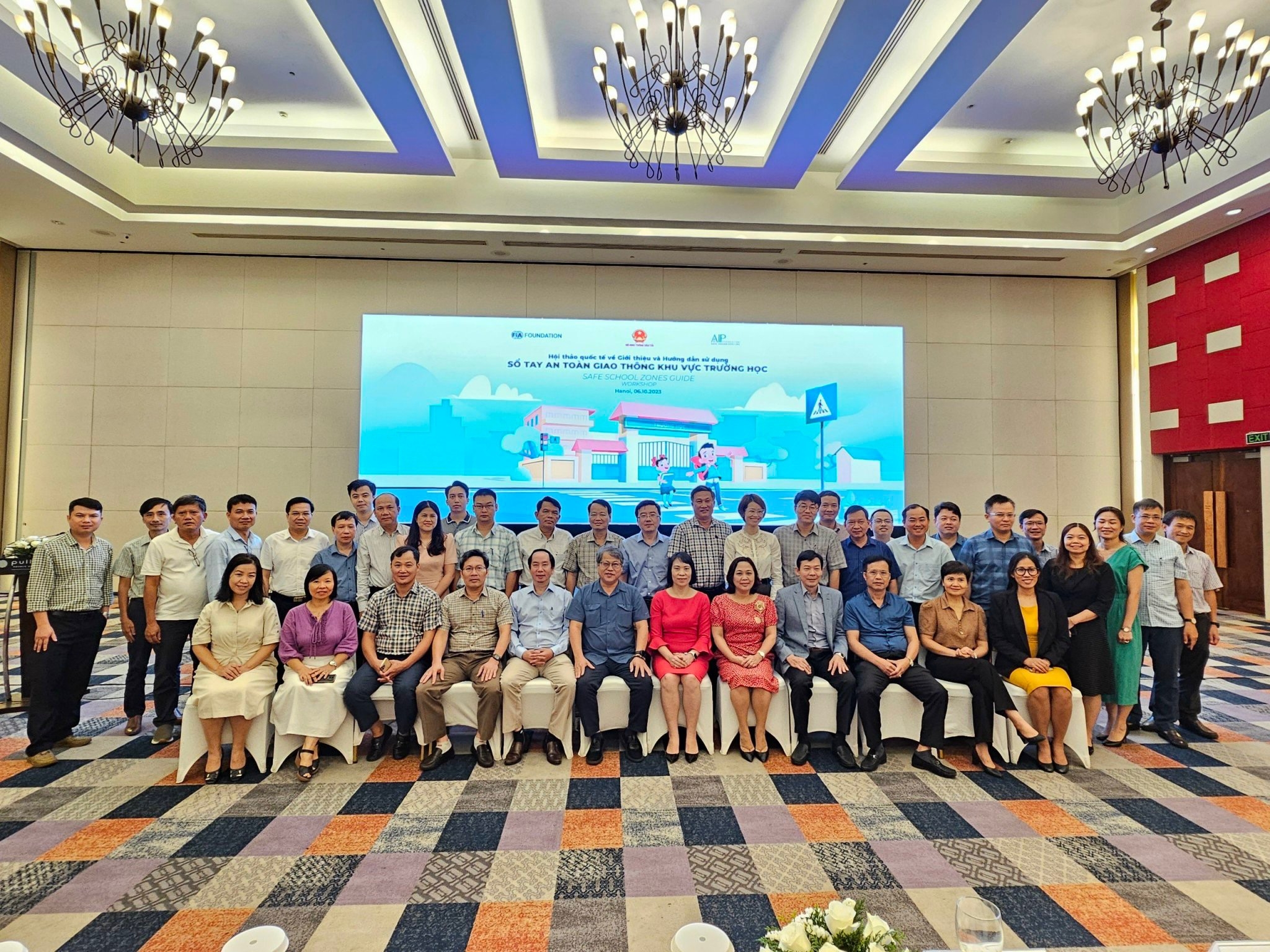
The Ministry of Transport, in collaboration with the nonprofit AIP Foundation, is hosting and leading a national workshop on theSSZ Guidefor all transport stakeholders in Vietnam, including 63 Department of Transportation representatives from across the country. The participants will be introduced to theSSZ Guideand explore how to apply it in their own province. In addition, they will listen to the lessons learned by other Departments of Transport, including their experiences in piloting and implementing the school zone improvements.
At the workshop, Government partners will also be introduced to the Youth Engagement App (YEA) developed by the International Road Assessment Program (iRAP) together with AIP Foundation with support from Fondation Botnar and Anditi as part of theAI&Me: Empowering youth for safer roadsprogram. iRAP will present the data reported by students themselves as actionable recommendations for the Government to improve school zones around the country. Through YEA, students are empowered to speak up for safer streets in their schools and neighborhoods. The provincial governments can then use theSSZ Guideto address these unsafe areas.
\nPaving the way to safer streets for all students in Vietnam
In Vietnam, over 17 million children are commuting between home and school 2-4 times per day. Many children share the road with speeding trucks, with no sidewalks to walk on going to school. Alarmingly, traffic speeds around schools frequently and significantly exceed internationally recommended school zones’ speed limits.
To safeguard the lives of young students on their journeys to school, AIP Foundation, in partnership with the FIA Foundation, has developed theSSZ Guide.Two years in the making, thisSSZ Guideis a reliable blueprint to address on a larger scale the safe mobility issue around schools across the country.
Aggie Krasnolucka, Programmes Director of the FIA Foundation, said ”TheSafe School Zones Guide Vietnamis a significant milestone in the work of AIP Foundation to ensure every child has a safe and healthy journey to school. The national roll-out of the guide supports every province to embed the safe-system approach and youth participation into transport design, making journeys safer for all.”
AIP Foundation and the Ministry of Transport held a signing ceremony to kick-start the program in Hanoi, in October 2021. Both parties officially committed their roles and responsibilities for the national project. TheSSZ Guideaimed to provide a policy and procedure framework for safe school zones to be constructed and implemented around the country.
In September 2022, theSSZ Guidereached a significant milestone with the Ministry of Transport issuing the first edition of theSSZ Guideas an official reference document – thereby allowing it to serve as a government-endorsed resource for local authorities to assess and implement solutions to improve traffic safety conditions in school zones.
Piloting the SSZ Guide across three regions:
TheSSZ Guidewas piloted at three school locations in Hanoi, Nghe An, and Soc Trang provinces – representing three geographic regions in Vietnam – from October to December 2022. It was first applied to assess the infrastructure around these schools. Based on this assessment, road infrastructure modifications were designed and implemented accordingly– including the installation of pedestrian crossings, rumble strips, school zone signs, and 30 km/h speed limit signage.
Overall, multiple methods were used to evaluate the effectiveness of the SSZ Guide in reducing traffic risks for student pedestrians, including assessing pre-and-post infrastructure interventions using the Star Rating for Schools (SR4S) tool developed by iRAP, measuring traffic conflicts and near-miss scenarios between student pedestrians as well as focus group discussions. The successful pilot results indicated that:
– Road safety conditions in all school zones improved. Schools were upgraded from 1 or 2 stars before intervention to 4 or 5 stars after intervention (out of 5 stars being the safest).\n– The number of crashes occurring in the school zones decreased by nearly 21% after the intervention.\n– A decrease in the traffic conflict rates between pedestrians and vehicles was observed in Nghe An (by 4.28 conflicts/hour/1000 vehicles) and Soc Trang (by 5.17 conflicts/hour/1000 vehicles).\n– Focus group discussions with students, parents, and teachers convey that theSSZ Guidehas influenced their perceived feeling of safety around school zones.
“We are so proud to collaborate with the government of Vietnam to enshrine the right of every student to travel to and from school safely. This our biggest achievement since the Helmet Law passed in 2007. ThisSSZ Guidemarks a monumental shift toward safeguarding our future generation,” shares Mirjam Sidik, Chief Executive Officer at AIP Foundation.
Together, we can build a world where every person can move safely, fairly, and freely. Join us in delivering sustainable and equitable mobility to communities around the world by donating today.



Stay informed with our latest mobility highlights every month!